

'Energy Performance Certificates' are playing 4d chess
What are EPCs for? And are they doing what they are intended to do?

When you moved into your flat in the UK, the chances are that you didn’t pay attention to this diagram.
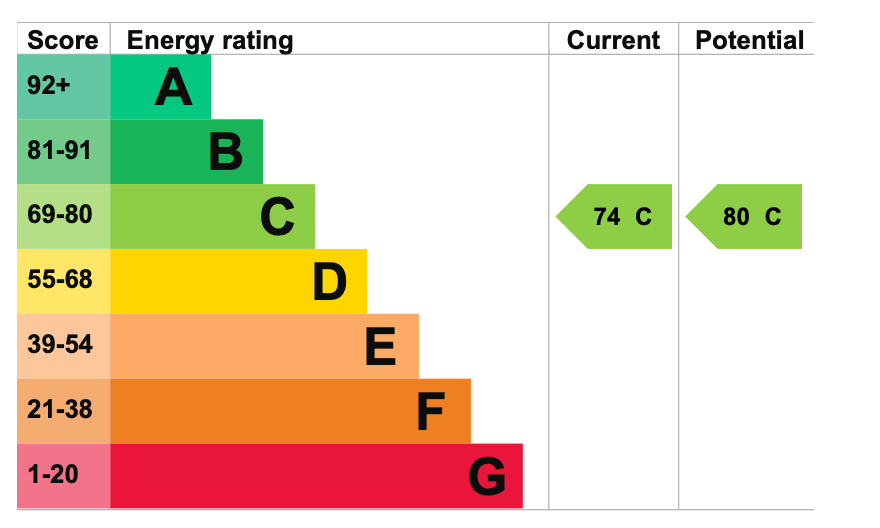
Neither had I. Life is too short to read documentation, and plus I’d noticed that every flat I looked at had a similar diagram with similar colours, so I just assumed it all meant pretty much the same thing. It was more natural to fixate on the size of windows and how many minutes I am from a good croissant.
This diagram is of course an Energy Performance Certificate, and the fact that I overlooked it wasn’t just me being uniquely profligate and inattentive. When you’re renting or buying flat, there are so many variables that you could base a decision on, but at the end of the day they pretty much all get trumped by the combo of upfront cost and vibe. In a country where people spend 33% of their income on rent, and will need to fight off twenty other people to sign the lease on a hovel, people aren’t worrying about the colourful little energy estimate, given that their rent might be more than 10x the cost of heating the place anyway. They’re so low down people’s priority lists that only about most people don’t know their own EPC.
But let’s say you move into a flat, and after a few months of working out what you can and can’t afford given your new rent, you do eventually suspect your energy bills are quite high and might be worth looking into, and you take the bold step of dredging up all the random documentation your letting agent sent to you as you rushed to sign the lease, and you find your Energy Performance Certificate report.
Perfect! you think, now I finally know where all my money has gone. The one I have shared in this post is actually my real EPC from my flat in South London. It has a diagram and an accompanying report. My score is 74, band C, which is above the average of D for UK properties. Tragically, I am doomed to mediocrity: my ‘potential rating’ is barely higher.
It is not the intention of the report to do so, but it is extremely discouraging regarding doing anything to improve the efficiency of my home. Here is an excerpt.
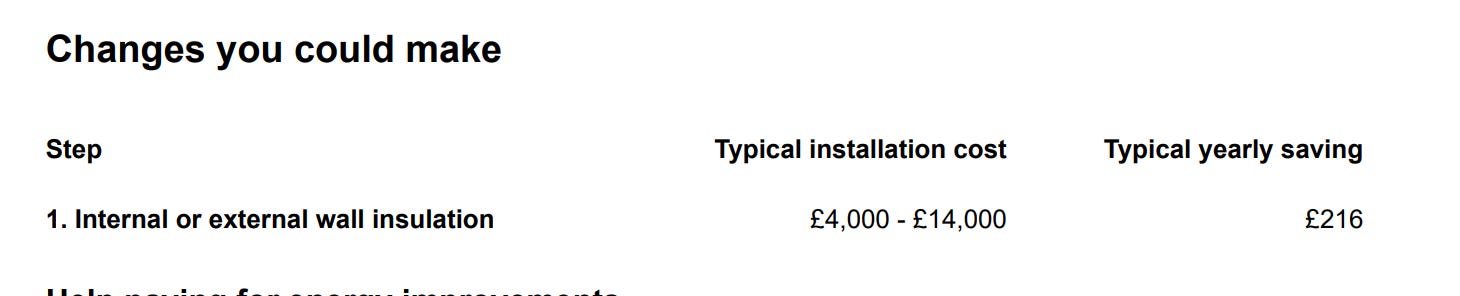
If I live in this house 20 years, I might be able to recoup the cost of my insulation! Winner!
Making sense of the top-line EPC rating is difficult. Practically speaking, the number 74 doesn’t really represent anything in particular: it is an index value designed simply to facilitate comparison between properties. In isolation it’s hard to understand, except at the limit where a property rated 100 would have zero net energy costs. I have found that my flat costs roughly the same amount to heat than other flats I have lived in previously in London, and to a certain extent this is confirmed by my mediocre EPC score. However, I don’t think a score of ‘C’ on its own would have communicated much to me were it not for having experience of living in other places. This is also because the figure given in my EPC report which accompanies the diagram of my estimated kilowatts of usage per square metre of ‘primary energy use’ is not firm enough for me to benchmark my own usage against. If I always go lower than that number — which I do — I assume that I must just be a Spartan kind of guy, happy to go Wim Hof mode in the shivery months.
When you get your EPC done, a qualified assessor comes round and takes some measurements and sends you a PDF. It is all rather perfunctory. It is a bit like a dentist knowing how much you’ve flossed — and consequently, how much you’ve lied about flossing — as soon as they look into your mouth.
This is all just vibes, but there are numbers which back up the vibes too. In 2023, a Sunday Times report found that EPCs were ‘staggeringly inaccurate’, with about 8 of 11 homes having their energy usage systematically overstated—by 52 % for band D and up to 161 % for band F.
While one might say this is good news, because we are really more energy efficiency than we thought, in truth it is not. The issue is that 2.5% of houses are rated lower than E, which according to government rules means they cannot be mortgaged. While it’s hard to tell what overall effect this has on the housing market, it certainly can’t help. A situation in which there are likely thousands of houses not able to be sold due to unfairly estimated energy ratings is not ideal.
When this research was published, industry bodies involved in the production of energy assessments responded that ‘EPCs are a modelled cost profile of a property’, and not a measure of the ‘actual energy use’. The argument is that the EPC can only be understood as a baseline, and that it accepts inherently that the lifestyle of the occupier will incur additional energy costs on top of the baseline.
On some level, this strikes me as a valid response from the perspective of the EPC issuing bodies. They have developed a protocol and a metric for assessing energy efficiency, and as far as I can tell they are fully transparent about the assumptions and limitations of the metric.
Yet the Sunday Times research does point to a valid cause for concern. Whatever the intentions of the original EPC metric is, it has nonetheless become a currency used to measure the impact of a number of house-building and net-zero government strategies. The Johnson government claimed to have increased the proportion of homes with an energy efficiency rating of C or above by more than threefold to 46%. The Starmer government appears to be aiming to keep to similarly strict targets.
It is rare that you can use a metric in discussions about national-scale investment and still have the subtleties of the metrics caveats included within that conversation. This is true of energy efficiency as it is true of house prices, the unemployment rate, GDP. Those numbers will always used by more people who don’t understand all the nuances than do. Because EPCs are being used in net-zero chat, it should not be surprising that they have been taken to indicate ‘how much energy a household uses’, rather than ‘the baseline amount of energy a household would use given a minimally-demanding householder’. This sort of slippage means that EPCs are giving inaccurate pictures of how domestic energy use works at scale.
What’s more, given what these EPCs are communicating you have to ask whether money invested in ‘improving’ those homes to meet the fake EPC rating is money well spent. It’s also not very impressive to announce a massive increase in energy efficiency when by your own standards there was no need to increase energy efficiency.
One sometimes hears the slogan the purpose of a system is what it does, and while it is not true, it still has that mouthwash feel that provocative ideas have, of blasting your head a bit, refreshing it, leaving a lingering ambiance. When applied to energy efficiency ratings, you could say something like given that energy ratings systematically overstate houses’ energy usage, the purpose of the energy ratings system to make people think their homes use more energy than they actually do.
It is quite fun to argue this, and like with all properly cynical arguments everything starts to look like evidence. EPCs were introduced to the UK property market by an EU directive motivated by the Kyoto Protocol committing states to reduce their greenhouse emissions. This is a classic pattern, where the push to get better data on something is not neutral, but done with the idea that once you know about the size of a particular metric, more people will see it as a problem and start doing something about it. While the EU directive clearly did not intend to produce a situation where most houses are rated as worse than they actually are, it could be viewed strictly speaking as a positive side effect with respect to the aim of reducing emissions if it encourages more aggressive emission reduction policy.
EPCs are simultaneously hard to reason about, probably unreliable, and yet very expensive policy decisions have been made on the back of them. This seems like a mess. And yet, not every mess is a problem. It is very often true that a weak and unreliable signal is better than no signal at all. I have worked for years building data and ML applications, and have seen many examples of outputs which can be extremely useful and guide real-life decisions very well despite having a confidence interval between 85-90%. If most EPCs are systematically too harsh, then at worst we can iterate on them, and optimistically-speaking we have some knowledge where we had none before. It is also not beyond the wit of man nor agents to devise something better, which will happen soon.
I may well have been spending too much time around Progress-aligned people and guys with Let’s Fucking Build t-shirts — but a discussion like this always begs the question of what happens when we just lower energy costs? It’s obviously a good point, and I am fully on board with the animating spirit behind it. EPCs are a second or third order consequence of expensive energy, and their oblique weirdness is a consequence of bureaucracy. But they are still worth looking into, because I am not confident in the ability of the government of the United Kingdom to give us energy too cheap to meter and low emission enough to ignore.
So what are EPCs for? There are generally two paths for a new metric when it is regulated into a market.
The first is to reveal hidden traits. For example, a restaurant hygiene grade tells you whether the chef washes his hands. It is not something you would have known otherwise, so it is helpful. However, by their nature, such ‘hidden traits’ produce noisy metrics because they are hard to measure, so buyers often discount these kinds of things as we have seen above.
The second is Goodhart’s Law-ish. You create a metric and then legislate when the metric is ‘bad’. It is basically an excuse for policy making.
The EPC is stuck halfway between these two functions. It isn't granular enough to price homes accurately, yet it is sharp enough to trigger fines and mortgage friction. But this tension is where some interesting economic patterns emerge. Here are just two.
First, there's the issue of risk pricing. Banks have begun integrating EPC data into their climate-stress models. What this means is that a poor certificate today doesn't just affect your current mortgage options—it sets the credit terms of tomorrow. The Bank of England's Prudential Regulation Authority has explicitly included EPC ratings in their climate risk assessment frameworks, requiring lenders to factor energy efficiency into their long-term lending strategies. In other words, your EPC is becoming part of how financial institutions evaluate the future value and risk of your property in a carbon-constrained world.
Second is a data flywheel thing. Every smart-meter reading collected today is basically evidence that can be weighed against the static predictions of yesterday's EPC assessment. The wider this gap gets between real-time energy use and the certificate's estimate, the stronger the case becomes for a dynamic, API-connected rating system that updates continuously; like a credit score that evolves with your behaviour.
How much impact either of these two will have remains to be seen. In any case, I think it is fair to claim that EPCs are useful, could be more useful, even though in an ideal world they would not be relevant at all.
I am building in architecture+AI+construction. I want to talk to anyone who knows about designing buildings and is trying to get tech to help them. Please message me!