

Should the City of London convert its empty offices into homes?
The City has been blocking it. Should I mount my high horse?

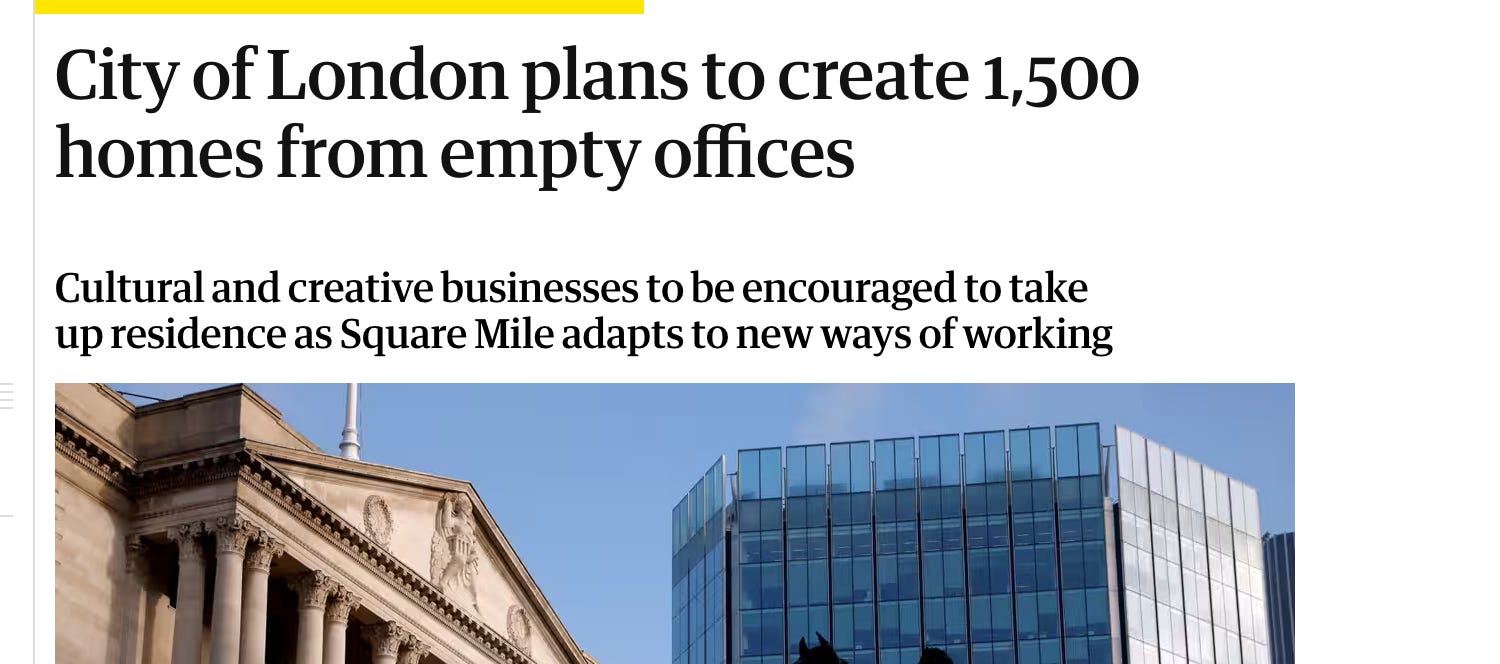
In April 2021 there were some headlines in UK papers suggesting that the City of London was going to make 1,500 new homes out of old office space. You remember the pandemic, right? OK, so you probably recall that London was still more or less locked down, so people had time to fill with speculation. At the same time, because lockdowns were starting to ease, and it looked like some freedom might be on the horizon, one thing people were thinking about was what the world would be like once they were allowed back in it.
The emptiness of central London at that time was awful, but in the old sense of that word. While in Brixton, where I lived, the streets felt cozy, since at all times you could see and feel the houses full of their inhabitants, in the Square Mile the offices and cafes and pubs which were designed for massive volumes had had their contents expelled like lungs on an outbreath, clearing too the bronchioles of the tube lines and bus routes.
Most offices in the City had been empty for a year, and I remember a theme of conversation was what might happen to all that space now that remoteness had become the norm. Some people I knew became Warren Buffett, saying nice big things about the future of the real estate sector and fluctuations in demand. “Price is what you pay,” they liked to murmur.
It was in this imaginative world that the figures about thousands of new homes in the City had their effect. It was radical, and yet it was entirely in keeping with the feeling that anything other than radical change was betraying the spirit of the crisis. If the headlines were to be taken at face value, and all the new homes were added at once, it might have meant up to a 40% increase in the permanent population of the City, which is a jump that simply never happens in other boroughs.
There was also an undeniable demographic logic to the proposals. The City is one of the least densely-populated boroughs in the country, and is right next to Tower Hamlets, which is the most densely populated. It made sense to ease pressure on one by opening up the other.
And yet it will surprise no one who pays attention to the details of planning that the headlines were wrong. The 1,500 figure came from a Covid recovery strategy document published by the City Corporation which projected that there would be ‘at least 1,500 new residential units by 2030’, and was actually just an extrapolation of the Mayor’s target for adding about 150 homes a year to the City’s housing stock.
It also won’t be a surprise that the headlines weren’t simply wrong, but that they were the opposite of the truth. The City Corporation was in fact doubling down on ‘return to the office’ and not prioritising residential space to any significant degree, despite there being a movement towards converting offices to residential in the rest of the country. A few years ago, the City managed to get itself exempted from national rules that allow developers easily to convert space from office to residential. City Policy Chair Catherine McGuinness said ‘the City is going to remain predominantly a business area and we are not planning to change that.’
When you look at the recent history of City of London, it’s clear that this position is fully consistent with their longer-term policy strategy. At no point have they have ever exhibited a particular interest in residential conversions. The City Plan 2040 document, published last March, declares support for ‘protecting strategic office locations’, and aims to ‘ensure that areas are not undermined by office to residential permitted development rights’. While there will be some new housing built in the City, the plans convey that the preference is absolutely for protecting commercial real estate uses.
There is a housing crisis in the UK whose chief cause is a supply bottleneck. Housing shortages are responsible for an enormous range of social and political problems, and the single thing a government could do with the greatest potential to improve the UK would be to increase the supply of housing.
With this granted, the City’s firmness in blocking mass-scale conversion of offices to housing might seem narrow minded. But of course there are a number of good reasons why they would do this. The City is the City because it is very productive per square foot. As many might guess, it is the most productive place in the United Kingdom, about twice as productive as the national average. And the idea, once a truism in the Covid-recovery era, that there are acres of empty offices in the City like the ruins of a fallen empire, is becoming less real by the month as companies vibe-shift their way back into the material world. The point is that the geographical City is fast overcoming the Covid shock, and the commercial real estate is nearing its usual productivity once again.
There might arrive the objection that such a concentration of economic activity is perverse in some way, that it represents a lopsidedness highly characteristic of the UK. After all England is far richer than the other members of the Kingdom, London is far richer than other English cities, and the City is richer than other London boroughs. The Chancellor herself has made arguments about the UK economy being over reliant on City-based financial services. However, even if this is a problem, which is up for debate, there is a difference between addressing the causes of a problem, and using the causes of a problem as an excuse to do something else, which would be the case if we decided to bonfire the City’s office stock in the name of a more diversified UK economy. Fundamentally, agglomeration economies in which workers and firms derive benefits from proximity are important, and the Square Mile is a prime example.
The City should be allowed to be excellent at what it’s excellent at, and shouldn’t be required to compensate for the problems caused by other boroughs and by national governments. It has exorbitant comparative advantage in financial density, and it if lost that the country as a whole would lose productivity and tax receipts.
The City of London is wielding its instruments well against residential conversion, but acknowledging such does not lead down a slippery slope to NIMBYism, for the exception in this case certainly proves the rule. If one were to generalise a test from the case of the City, it would be something like:
Anti-housebuilding regulatory instruments are permissible IFF the
The current non-housing state of affairs has a measurable positive impact on the nation as a whole
The measured positive impact of the non-housing state of affairs to the nation is greater than that accrued by increasing housing in that area.
The emphasis of this test is different to a usual cost-benefit analysis, as it places the burden of proof on the status quo of not building, rather than on the builders. The City can claim to be able to measure a positive impact on the nation, rather than simply on the people who are residents or workers there, and that claim can also be measured to be greater than the housebuilding. The same would be much harder to justify in Earl’s Court, for example.
The City feels busy again, and although tube journeys might not be back to pre-Covid levels, I suspect Lime bikes have eaten up some of the demand and that people are travelling around London just as much. You still get pushed off pavements, pubs swell, and queues for salads disappear over the horizon. Office landlords are getting more flexible with their leases and understanding hybrid working. A new exercise class is invented every month. There is life here, and while it is not as strong as it could be, and might not understand the world and its future like it should do, it is nonetheless quite unique in this country for one simple reason: elsewhere the sight of a queue for a bus, a busy and crowded street, and traffic cones blocking the road, would get me despairing about our urban decay, lack of investment, and crumbling infrastructure. In the City of London, seeing such things makes me optimistic. It is, again, the exception.